Saturday, October 10, 2015

Housing

Hello family and friends. I am now more than a month into my mission to Paraguay. I can confidently say that being here for one month has been the most challenging undertaking of my life. Living away from home, having a language barrier, and experiencing extreme poverty all hit me for the first time at the same time. After this experience, probably not many things will seem all that difficult in comparison.


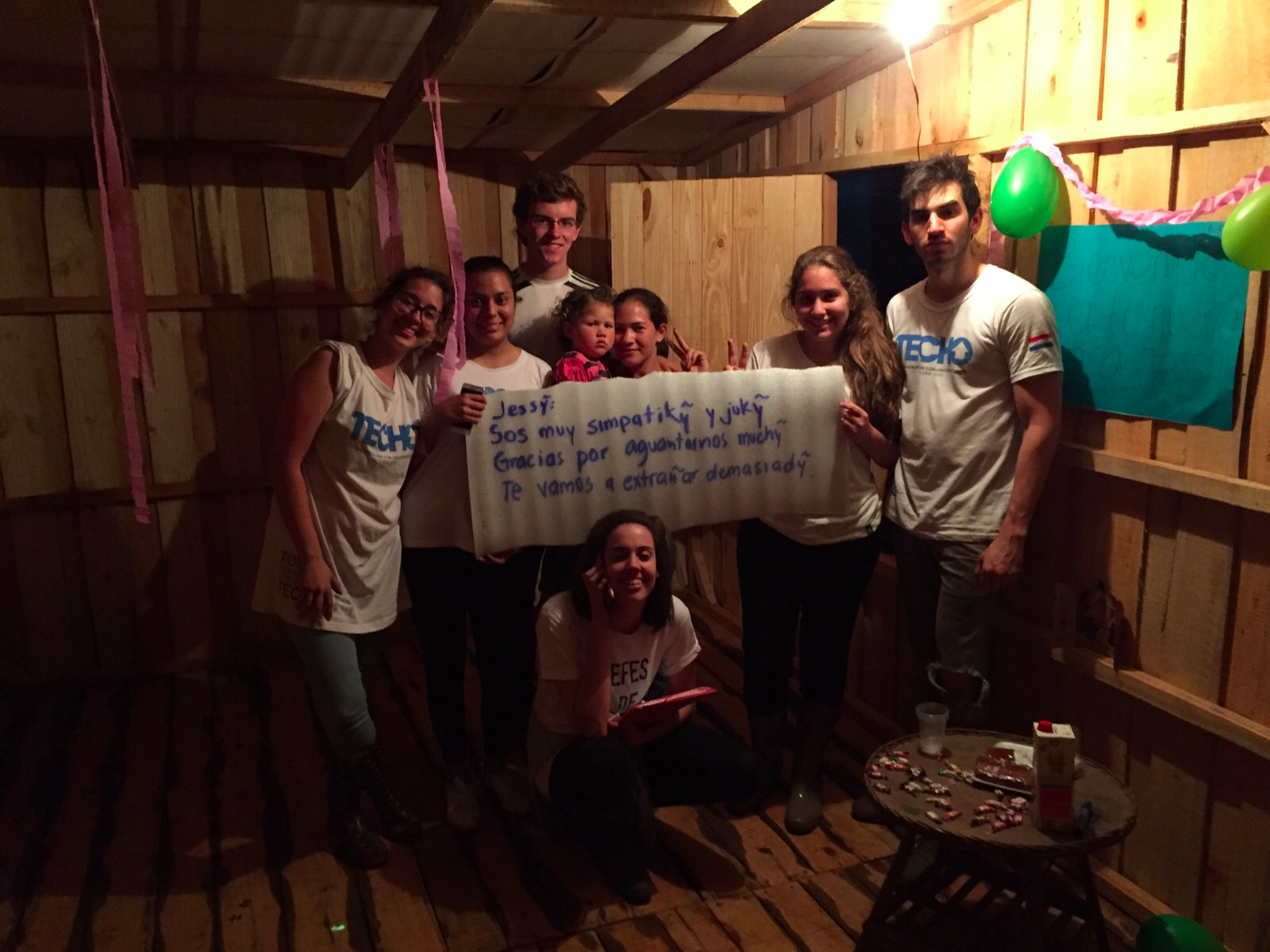
This past weekend, I went on a two-day mission trip with one of my friends from the parish here. We worked with a huge mission organization here in Paraguay named Techo (Spanish for roof or ceiling). Roughly six-hundred college-aged kids met in Asunción on Friday night, and these kids were separated out into fifteen groups, with each group going to a different poor neighborhood in the greater Asunción area. Then, each of these fifteen sites built eight houses for families who had previously been living in very run-down and precarious houses. So in total, Techo built 120 houses last weekend. Below are some pictures of the house that my group built for a twenty-two-year-old single mother and her three-year-old daughter. Although it is still a very small house (10x20 feet) with no plumbing or electricity, it is an enormous improvement from the house where the family lived before. In the first photo you can see the old house behind me.




I continue to work at the after school program five days a week for the kids that live on the dump. I have become the secondary math teacher at the program because this is the subject that requires the least Spanish. Despite the lack of Spanish required in math, you’d be surprised how hard it is to teach the simplification of improper fractions to kids who don’t speak your language. In the past two weeks, I have gone on two field trips with the kids. These field trips are probably the most important activity that the after school program has to offer. Apart from these field trips, the kids from the neighborhood on the landfill never leave the proximity of their houses. With grades four, five, and six, we visited the national zoo, and with the middle-schoolers, we went to a different Franciscan house in the interior of the country for an extremely crazy night. These field trips allow the kids to experience something beyond the walk back and forth to and from school, and the trips show the students the world of those who have money. Ideally, the field trips reveal to the kids of how much better the quality of their lives could be if they could just break free from the bondage of the poverty. Having a vision for a better life is the first step.


Seeing poverty on such a large scale has certainly engaged my faith in God. I am far too optimistic to believe that living in this type of misery could ever be the plan for the entire life of a person, let alone the lives of the 1.2 billion people worldwide who subsist off of $1.25 or less daily. These people are meant for more. “Blessed are you who are poor, for the Kingdom of God is yours. Blessed are you who are now hungry, for you will be satisfied. Blessed are you who are now weeping, for you will laugh” (Luke 6:20-21).


Thank you all so much for reading. Also, thank you to the many people who sent me emails and messages checking up on me. I’m really happy to know that people back home are keeping me and the people I serve their prayers. I miss you all very much.


Peace and goodness,

Jack

Tuesday, September 22, 2015

Beginnings

Hello family and friends. Before saying anything else, I would like all of you to know that I am happy and healthy, and I am a little over two weeks into my nine month mission to Paraguay.

I’ll be living the majority of time at a Franciscan house just outside of Asunción, Paraguay’s capital city. The Franciscans are a religious order within the Catholic Church who seek to follow the teachings and lifestyle of St. Francis of helping the poor while living simply. Living in the house with me are a priest, a friar (soon to be a priest), a keeper of the house, and four seminarians, people studying to be priests. On one side of the house, there is the national seminary for Paraguay, so the seminarians take classes in philosophy and theology there every day.

On the other side of the house lies the expansive and seemingly endless landfill of Asunción where all the city’s garbage is dumped. Inside the landfill live approximately ten thousand people. Each day the majority people of the “Basural” leave their homes before dawn and walk a couple miles to the other side of the landfill to work. Their work consists of digging through the fresh trash and finding things that they could resell to make some kind of money; they are usually lucky to make a dollar for a day’s work. Because of this, many people do not have enough money to buy food so they are forced to eat scraps of discarded food that they find in the trash. Thankfully there is a functioning public school system here, so some of the kids attend classes and get a free lunch there. Not all the children go to school who are of age because they have to work in the landfill to provide money for their families. Many small children never leave the proximity of their houses because they are too young for school and too young or malnourished to work. Below are a couple photos of the houses in the landfill.


IMG_4375.jpgIMG_4380.jpg
At this point, it seems like my primary work in Paraguay will be working in the after school program at the house. Each weekday after classes, kids from the landfill come to the house and are helped with their homework and retaught some of the concepts learned in school. I have worked in the classes for four days. The task of educating a class full of fifteen-year-olds seems daunting enough when in an American school. For me in Paraguay, the burden of that task is multiplied many times because I have to work hard to communicate with them because of the language barrier. To add to this, the majority of the students seem to have no kind of motivation to learn because they can see no way out of their poverty. The majority of the time kids text on their phones, which are almost certainly stolen. What use is learning geometry going to do them if they spend their lives sifting through trash like their parents and grandparents?


It is extremely easy to look at the situation here and lose every ounce of hope for the thousands who live in the endless and inescapable cycle of extreme poverty. With faith, however, there is hope. Each one of the people living in destitution has a God that loves them, and each was created with a unique purpose. The central goal of the education at the after school program must be to get it into the kids’ minds that it may be possible for them to make it out of the cycle of poverty and off the landfill if they focus while they're young and learn how to read fluently and memorize their multiplication tables. They can make a difference and change the society that has denied them of their most basic needs. Below is a picture of the building where we have the after school program.
IMG_4381.JPGThanks for reading. My mom has told me that many people have been asking about me, and I’m very grateful for you all keeping me in mind. I’m hoping that this blog can serve as a testament to how powerful and transformative a mission year can be. I miss you all so much, and keep me in your prayers. If any of you need anything at all or just want to say hi, just send me a message on facebook or email me at john.mj.murphy@gmail.com, and I should get back to you within a few days. I’ll post again in about two weeks!


Peace and goodness,

Jack